



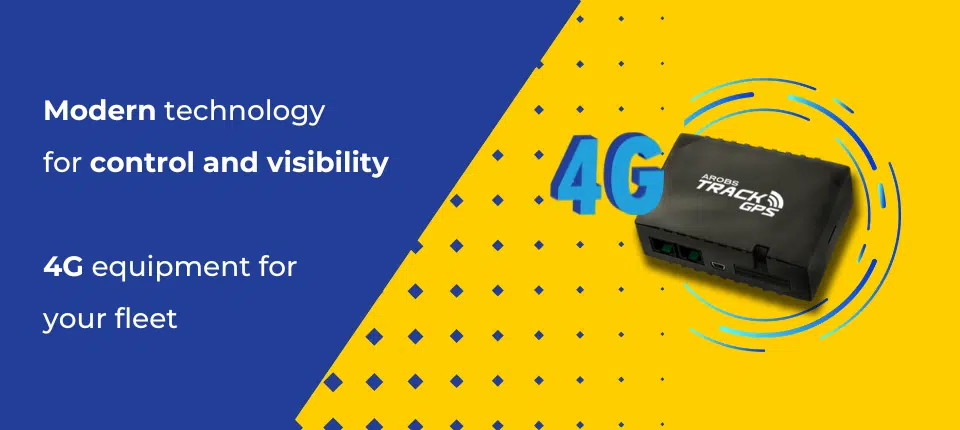
Fleet management digitalization started for many companies with a simple goal: seeing where the vehicle is located. Ten to fifteen years ago, 2G technology devices and a basic platform could easily accomplish this task. Today, however, market requirements have changed radically: localization alone is no longer enough. Companies now need complete information transmitted quickly and integrated with the actual operation of the vehicle (fuel consumption, driving style, idle times, temperature, operational events), as well as support for video data, mobile applications, and integration with internal systems.
In this process of evolution, the difference between 2G and 4G technologies goes far beyond data transmission speed. It is a difference in reliability, capacity, wider coverage, compatibility with new services, and, most importantly, continuity: many 2G networks have already been shut down in various countries or are receiving limited investment, while 4G remains the backbone of mobile communications for the coming years. For transport operators working both in Romania and internationally, migrating to 4G is no longer just a “nice to have” feature, but an operational protection measure.
About 2G and 4G – what you need to know from a fleet management perspective
2G (GSM/GPRS/EDGE) is a technology designed in a time when mobile phones were primarily used for voice calls and messages. Mobile data exists, but at limited levels: low bandwidth, congestion in crowded areas, and infrastructure that is “aging” in many places.
4G (LTE) is a modern data technology designed for unlimited mobile internet: significantly higher capacity, better transfer stability, superior mobility support, and compatibility with complex applications (video, advanced telematics, driver applications, etc.).
In telematics, these differences can be directly observed through:
The speed of position transmission to dispatch;
The speed of transmitting various events (e.g. refueling, unloading, door opening, engine stop, temperature threshold exceeded);
How consistent the connection remains on long routes;
The ability to transmit larger volumes of data (e.g. detailed logs, fuel consumption charts, frequent CANbus data, video images from cameras);
How easily a continuous roaming data flow can be maintained.
Relevant technical differences: speed, latency, capacity, stability
Speed: 2G is practically designed for low data traffic. A location ping can be transmitted, but it becomes fragile when additional demands appear: frequent intervals, multiple sensors, detailed reports, updates. 4G provides enough bandwidth for advanced telematics and the natural evolution of modern solutions.
Latency (delay): in transportation, even a few extra seconds can lead to wrong decisions: routing, delivery confirmation, incident response, temperature monitoring. 4G has significantly lower latency, making “real-time” information realistic, not just theoretical.
Network capacity: in cities, large parking areas, and logistics terminals, networks become crowded. 4G handles user density much better. 2G can become unstable precisely in the places where accuracy is most needed (logistics hubs, warehouse entrances/exits, border checkpoints).
Stability while moving: 4G is optimized for mobile data transfer, with smoother transitions between network cells. In practice, this means fewer data “gaps” and cleaner route visibility.
Romania vs the European Union: why it matters for transport operators
Romanian transport operators frequently perform international transport routes: Hungary, Austria, Germany, Italy, France, the Benelux countries, Poland, etc. The difficulties created by 2G technology are not limited to Romania or the European Union, but apply across all the countries crossed.
Across the European Union, operators have evolved differently. Some have kept 2G for compatibility reasons (M2M, older equipment), while others have reduced investments or already shut down older technologies (especially 3G, and in some cases even 2G). Often, 2G remains only as a safety net with limited capacity, while network priority clearly shifts toward 4G/5G.
In Romania, 4G coverage is good across most major road corridors and urban areas, although there are still rural or geographically challenging areas where signal quality may fluctuate. Here, a properly designed 4G device with multi-band support and reliable signal fallback behavior offers superior stability compared to 2G. And for fleets crossing borders, the 4G advantage becomes even greater: in roaming scenarios, 2G can be unpredictable, while 4G is the current standard.
The cost of 2G equipment in fleet management
In fleet management, costs are not limited to subscriptions or equipment. The real costs are the “invisible” ones:
Operational decisions based on delayed data
If position updates arrive every 2–5 minutes instead of every 10–30 seconds, planning is affected: ETA calculations, dock allocation, customer coordination.
Incomplete data for analysis
Fuel reports, frequent events, driver behavior, idle times, or technical vehicle parameters may require more frequent transmissions.
Limitations when integrating sensors and devices
Temperature, doors, fuel level, weight, special devices — all increase data volume and the need for reliability.
Risk of unavailability in certain countries/areas
Given the pace of technological evolution, 2G availability may disappear at any moment, in any region.
Why 4G is necessary for transport operators
Transport is an industry where margins are won through control: control over fuel consumption, time, maintenance, compliance, and risks. 4G supports exactly this type of control through:
Denser and safer telemetry (more data, transmitted more frequently, with fewer interruptions);
Fast response to deviations (temperature, unauthorized routes, unplanned stops);
Scalability: adding 50–200 vehicles or another 2–3 types of sensors does not create a network bottleneck risk;
Compatibility with platform evolution: any modern fleet management platform naturally tends to become increasingly complex.
Why AROBS TrackGPS 4G equipment is the logical choice in this transition
It is important for 4G technology to be implemented within equipment designed specifically for fleet operations and vehicle integration. When discussing TrackGPS 4G equipment, one key aspect deserves highlighting: CANbus and sensor compatibility.
CANbus (Controller Area Network) is essentially the vehicle’s “internal language” used for communication between modules. Accessing CANbus data through compatible equipment allows you to collect much more relevant information than simple localization:
RPM, actual speed, engine load;
Estimated fuel consumption, fuel level (depending on vehicle and parameter availability);
Engine hours, idle times, usage;
Errors/diagnostics;
Driving style and events relevant for training and safety.
Additionally, sensors extend operational control beyond vehicle data:
Temperature sensors for refrigerated transport;
Door/compartment sensors (anti-theft, compliance, delivery events);
Fuel level sensors for validating refueling operations and detecting losses;
Additional inputs/outputs for auxiliary equipment, depending on operational requirements.
4G is operational insurance
A transport operator using fleet management solutions should no longer ask whether “4G is worth it,” but rather “how much will it cost me if I don’t switch to 4G?” In an industry where delays, fuel consumption, and incidents can reduce the profitability of a transport route, connectivity becomes critical infrastructure.
And for AROBS TrackGPS users, transitioning to 4G equipment represents more than just a technological upgrade: it is an essential requirement for fully leveraging the advanced capabilities of the platform. AROBS TrackGPS 4G equipment is designed to operate fully integrated with the vehicle’s CANbus, enabling fast collection and transmission of critical data.
Moreover, extended compatibility with external sensors (temperature, doors, fuel level, or other transport-specific sensors) enables real-time monitoring of operational conditions and rapid intervention in case of deviations. 4G connectivity ensures that this data reaches the AROBS TrackGPS platform without significant delays, including in international roaming scenarios. Through this combination of 4G equipment + CANbus + sensors, the AROBS TrackGPS solution transforms the fleet from a set of vehicles “visible on a map” into a fully manageable, analyzable, and optimizable operational system.

![[TRAFICMEDIA] Why fleet digitalization is becoming essential in 2026](https://trackgps.ro/wp-content/uploads/2026/02/Blog-articol-Tranzit-1-1-150x150.png.webp)