



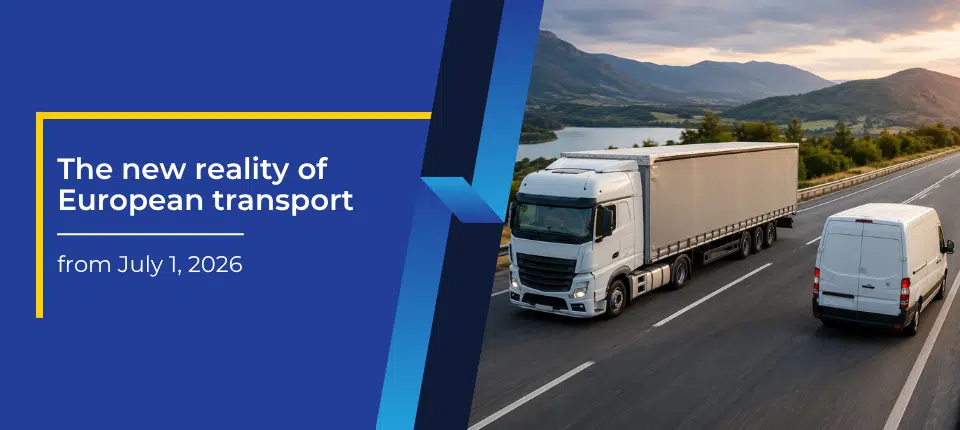
For transport companies, 2026 marks a significant shift in how fleets must be managed, monitored, and documented. The new European regulations do not simply introduce additional compliance requirements—they directly impact day-to-day international transport operations.
Starting on July 1, 2026, light commercial vehicles (LCVs) weighing between 2.5 and 3.5 tonnes and used for international transport or cabotage operations will be subject to much stricter rules. For transport operators, this means greater responsibility, more data to manage, and an increasing need for digital solutions that simplify operations.
Companies that prepare early will be able to turn these changes into a competitive advantage. Those that delay digitalization risk facing administrative errors, complex inspections, additional costs, and operational inefficiencies.
Light commercial transport enters a new compliance era
Until now, many fleets of light commercial vehicles have operated under simpler procedures than those applied to heavy goods transport. From 2026, this will change. Companies operating internationally will need to closely monitor driving and rest times, driver activities, completed routes, tachograph data, and the documentation required for bilateral transport, cross-trade operations, and cabotage.
These changes will have a direct impact on daily operations. Fleet managers will need to quickly identify which vehicles are affected, which drivers can continue their journeys, which data must be downloaded, and what information must be provided during roadside inspections. Without a centralized digital solution, all these processes can become difficult to manage and highly time-consuming.
What do the new regulations involve?
The new measures are part of the European Union’s strategy to harmonize working conditions and combat unfair competition in road transport. In practice, all companies operating vehicles between 2.5 and 3.5 tonnes in international transport will be required to comply with rules similar to those already applied to heavy-duty trucks.
The main changes taking effect on July 1, 2026 include:
- Mandatory installation of the Smart Tachograph Version 2 (G2V2);
- Compliance with driving and rest time regulations;
- Monitoring driver activities;
- Application of driver posting rules;
- Archiving and managing tachograph data;
- More precise and advanced digital inspections.
These obligations will affect all companies carrying out commercial transport operations across Europe using light commercial vehicles.
Operational impact: more than just the risk of fines
The new rules do not affect only the legal side of transport operations. They directly influence route planning, vehicle utilization, and driver management. A lack of clear visibility can lead to delays, traffic disruptions, prolonged inspections, incomplete documentation, or poor route-planning decisions. Furthermore, in cabotage operations, where administrative requirements are stricter, even minor documentation errors can generate additional costs.
For an active fleet, lost time means lost revenue. That is why compliance can no longer be treated separately from operational efficiency. Companies need complete visibility into their operations, real-time data, and tools that minimize manual intervention.
The smart tachograph: the beginning of the process, not the end
The introduction of the G2V2 Smart Tachograph is one of the most important requirements associated with the new regulations. However, simply installing the device is not enough. The real challenge lies in managing the data it generates correctly.
Data must be downloaded regularly, analyzed, archived, and correlated with driver activity. Without an automated system, companies risk losing important information or discovering violations of driving and rest time regulations too late.
This is where Tacho Analytics, developed by AROBS TrackGPS, comes into play. The solution is designed for companies looking to simplify tachograph data management and reduce the risk of non-compliance.
Tacho Analytics: better control, less time wasted
Tacho Analytics helps transport operators move from manual checks to a clear, automated, and easy-to-manage process. Companies can automatically download tachograph data, analyze driving and rest times, quickly identify violations, and securely archive information required for inspections.
For fleet managers, the benefits are substantial: all critical data is available in one place, eliminating repetitive exports, manual checks, and difficult-to-manage documentation.
The solution helps companies:
- Reduce the risk of fines;
- Eliminate many manual processes;
- Quickly identify compliance violations;
- Prepare more efficiently for inspections;
- Organize and archive tachograph data securely;
- Improve driver activity planning.
In an increasingly strict regulatory environment, Tacho Analytics is more than a compliance tool. It is a solution that helps companies save time, reduce risk, and make better operational decisions every day.
Complete fleet visibility with AROBS TrackGPS
In addition to Tacho Analytics, the AROBS TrackGPS platform provides transport companies with a complete overview of fleet activity. Real-time GPS tracking, route history, customized reports, and driver behavior alerts help fleet managers maintain better control over operations and costs. This level of visibility is especially valuable for international transport, cross-trade operations, and cabotage, where routes, stops, and driver activity must be properly documented.
By centralizing data, AROBS TrackGPS helps companies avoid situations where information is scattered across spreadsheets, separate applications, paper documents, and phone calls. The result is a simpler, safer, and more efficient way of working.
Preparing for July 2026 starts with digitalization
Although the implementation deadline may still seem distant, adapting to the new requirements takes time. Companies must assess their fleets, identify affected vehicles, establish clear processes for managing tachograph data, and ensure they have the right tools for monitoring and reporting. The sooner these changes are implemented, the smoother the transition will be.
Transport operators that adopt digital solutions such as Tacho Analytics and TrackGPS can reduce administrative pressure and transform compliance into a genuine operational advantage.
The Mobility Package 2026 is about more than additional regulations. It represents a new phase for transport companies, where accurate data, automation, and real-time control will determine the difference between vulnerable fleets and those prepared for the future. Contact us now!

